Category: Economic News

  • Honda Shine 125 Price Slashed After GST Cut – Check New 2025 Prices & Savings

    India’s popular commuter motorcycle, the Honda Shine 125, has just become more affordable. Thanks to a recent Goods and Services Tax (GST) revision on two-wheelers up to 350 cc, the bike now carries a lower ex-showroom price, making it one of the most attractive options in the 125 cc segment.


    Why the Price Dropped

    The GST on small- and mid-capacity motorcycles was cut from 28% to 18%. This change is being passed directly to customers, resulting in a noticeable reduction in the ex-showroom price of the Honda Shine 125 across its variants.


    Honda Shine 125: Old vs New Prices (Ex-Showroom)

    VariantOld Price (₹)New Price (₹)Approx. Savings (₹)
    Drum Brake85,59078,9036,687
    Disc Brake90,34183,2837,058

    (Prices are indicative ex-showroom Delhi; may vary in other cities.)


    Key Highlights of Honda Shine 125

    • Engine: 124 cc BS6 OBD2-compliant engine for smooth performance.
    • Mileage: One of the best in the segment for daily commuting.
    • Features: Modern graphics, CBS (Combi Brake System), and refined build quality.
    • Comfort: Upright seating, long seat, and improved suspension for city rides.

    What This Means for Buyers

    1. Lower On-Road Price: With the GST reduction, not only the ex-showroom but also the on-road cost drops once insurance and registration are factored in.
    2. Higher Value for Money: Buyers get the same refined engine and features at a lower price.
    3. Better Financing Options: Lower principal amounts make EMIs more affordable for budget-conscious commuters.
    4. Segment Advantage: The Shine 125 already dominates the 125 cc commuter market; the price cut strengthens its position further.

    City-Wise Impact

    Although the ex-showroom reduction is standard, actual on-road prices differ by state due to varying road taxes and registration fees. Prospective buyers should check with their local dealer to know the exact savings in their city.


    Tips for Prospective Buyers

    • Confirm Prices: Check the updated price list at your nearest dealership before making a booking.
    • Compare Variants: The disc brake variant now offers better braking for a marginally higher cost; the new lower price makes it even more attractive.
    • Look for Festive Offers: Combine the GST benefit with any seasonal discounts or finance schemes for maximum savings.

    Bottom Line

    The GST cut has made the Honda Shine 125 an even more appealing commuter motorcycle in 2025. Whether you’re upgrading from a lower capacity bike or purchasing your first two-wheeler, this price revision offers a chance to own a reliable and fuel-efficient motorcycle at a more wallet-friendly rate.


    Disclaimer: All prices and savings mentioned above are indicative ex-showroom figures as of 2025 and may vary by state, variant, and dealership. Customers are advised to check with authorised dealers for the most accurate and updated pricing.


  • Safal Product Price Cuts Post-GST Reform: What Consumers Need to Know

    In a significant move aimed at easing the financial burden on consumers, Mother Dairy has announced price reductions across its range of Safal processed food products. This decision comes in the wake of the recent Goods and Services Tax (GST) reforms, which have restructured tax slabs to benefit consumers. Effective from September 22, 2025, consumers can expect to pay ₹5 to ₹15 less on various Safal items, including frozen snacks, jams, pickles, coconut water, and tomato puree.

    Understanding the GST Reform and Its Impact

    The GST Council has recently overhauled the tax structure, reducing the number of tax slabs and lowering rates on several essential items. Under the new system, many products have seen their GST rates reduced from 12% to 5%, directly impacting the pricing of goods at the consumer level.

    For instance, Safal’s processed foods, which previously attracted a 12% GST, now fall under the 5% slab. This change has led to a direct reduction in the Maximum Retail Price (MRP) of these products, making them more affordable for households.

    Price Reductions on Safal Products

    As part of the price adjustments, the following Safal products have seen their prices reduced:

    ProductOld Price (₹)New Price (₹)GST Rate
    Frozen French Fries (400g)100955%
    Frozen Aloo Tikki (400g)90855%
    Frozen Nuggets (300g)1051105%
    Mixed Fruit Jam (500g)1801655%
    Tomato Puree (500g)1201105%
    Coconut Water (200ml)55505%

    Note: Prices are indicative and may vary slightly depending on location and retailer.

    These reductions are a direct result of the GST rate cut, with the benefits being fully passed on to consumers.

    Benefits to Consumers and the Supply Chain

    1. Increased Affordability

    The price cuts make essential processed food items more accessible to a broader segment of the population. Households can now purchase these products at lower prices, leading to reduced grocery bills.

    2. Boost to Packaged Food Consumption

    With more affordable prices, consumers are likely to increase their consumption of packaged foods, which are often more convenient and have a longer shelf life. This shift can lead to a rise in demand for such products.

    3. Support for Farmers

    The increased demand for processed foods can positively impact farmers who supply raw materials to companies like Mother Dairy. Higher demand can lead to better prices for their produce, improving their income and livelihood.

    4. Economic Stimulus

    The reduction in prices can stimulate consumer spending, especially during the festive season. Increased consumption can drive economic growth and support the retail sector.

    How to Maximize the Benefits

    To make the most of these price reductions, consumers can:

    • Purchase in Bulk: Buying in larger quantities can lead to greater savings, especially for items with a longer shelf life.
    • Stay Informed: Keep an eye out for promotional offers and discounts that may further reduce prices.
    • Compare Prices: Different retailers may offer varying prices; comparing can help in finding the best deals.
    • Plan Purchases: Aligning purchases with the availability of discounts can maximize savings.

    Conclusion

    The recent GST reforms and the subsequent price reductions on Safal products represent a significant step towards making essential food items more affordable for consumers. By passing on the full benefits of the tax cuts, Mother Dairy has not only alleviated financial pressures on households but also stimulated demand within the agricultural and retail sectors. As the new prices take effect from September 22, 2025, consumers can look forward to more cost-effective grocery shopping experiences.


    Disclaimer: The information provided in this article is based on the latest available data and is subject to change. Prices and GST rates may vary depending on location and retailer. Consumers are advised to check with local outlets for the most accurate and up-to-date information.


  • Mother Dairy Slashes Prices from September 22: Consumers to Enjoy Full GST Benefits

    In a major relief for consumers across India, Mother Dairy, one of the country’s leading dairy brands, has announced a significant reduction in the prices of its dairy and processed food products, effective from September 22, 2025. This decision comes on the back of recent Goods and Services Tax (GST) reforms, which have rationalized tax slabs and reduced GST rates on a wide range of items. Consumers can now enjoy affordable pricing across milk, ghee, paneer, ice cream, and other processed dairy products, reflecting the full GST benefit.

    Understanding the GST Reforms

    The GST Council recently implemented reforms aimed at simplifying the tax structure and reducing the financial burden on consumers. Key changes include:

    • Rationalization of the GST tax slabs to just two primary categories – 5% and 28%.
    • Over 350 items now have a reduced GST rate, effective from September 22, 2025.
    • Essential goods, including most dairy products, are either exempted from GST or fall under the 5% tax slab.

    These reforms are intended to stimulate consumption, especially during the festive season, by making essential products more affordable and accessible.

    Mother Dairy’s Initiative: What It Means for Consumers

    Mother Dairy has strategically adjusted the prices of its entire product portfolio to pass on the GST benefits fully to the end consumers. Here’s a snapshot of the changes:

    Product CategoryPrevious Price (₹)Revised Price (₹)GST ImpactNotes
    Packaged Milk (1 Litre)60582% savingsReflects GST reduction
    Ghee (500 g)3002855% savingsMore affordable for households
    Paneer (250 g)1201145% savingsEasier access for consumers
    Ice Cream (500 ml)1801705% savingsPrices adjusted for festive demand
    Butter (200 g)1601525% savingsEncourages more packaged consumption

    Note: Prices are indicative and may vary slightly depending on location and product variant.

    This reduction not only benefits consumers but also supports farmers and the entire dairy supply chain. By making packaged products more affordable, demand is expected to rise, which in turn can enhance income for milk producers and dairy farmers.

    Why This Price Cut Is Significant

    1. Increased Affordability: The revised prices bring essential dairy products within reach of a wider consumer base, making it easier for households to maintain their nutritional intake without straining their budget.
    2. Boost to Packaged Dairy Segment: With lower prices, consumers are more likely to purchase packaged milk, ghee, paneer, and other processed products, strengthening the formal dairy market.
    3. Support for Farmers: Higher demand for packaged products translates to better prices for milk suppliers and increased stability in the dairy farming sector.
    4. Festive Season Advantage: Price reductions come just in time for the festive season when household consumption of dairy products traditionally rises. This strategic timing encourages more purchases and enhances brand loyalty.

    How GST Changes Affect Daily Essentials

    The GST reform ensures that consumers directly benefit from tax reductions, without intermediaries absorbing the difference. In practical terms:

    • If a product was earlier taxed at 12% and is now under the 5% GST slab, the entire tax saving is reflected in the retail price.
    • For essential items like milk, ghee, and paneer, this can translate to a 5-10% price drop, which significantly eases the financial burden on households.
    • These adjustments also prevent hidden inflationary effects that sometimes occur when tax cuts are not fully passed on.

    The Broader Impact on the Indian Economy

    The GST rationalization and Mother Dairy’s proactive price adjustments are expected to have multiple positive effects on the Indian economy:

    1. Increased Consumption: Lower prices encourage higher consumption of dairy and processed foods.
    2. Formal Market Growth: More consumers are likely to prefer branded, packaged products, promoting transparency and quality standards.
    3. Supply Chain Efficiency: Higher demand ensures better utilization of production facilities, reducing wastage and improving supply chain management.
    4. Inflation Control: Affordable pricing on essentials helps in curbing food inflation, especially during festive and peak consumption periods.

    How Consumers Can Benefit

    Consumers can maximize the advantages of these price reductions by:

    • Switching to branded packaged products rather than unbranded alternatives.
    • Monitoring price changes at local Mother Dairy outlets to enjoy maximum GST benefits.
    • Planning bulk purchases for items like ghee, butter, and paneer to take advantage of the cost reduction.
    • Staying informed about festive offers and promotions, which often coincide with tax-based price adjustments.

    Conclusion: A Win-Win for Consumers and Farmers

    Mother Dairy’s decision to pass on the full GST benefit is a significant step toward consumer-friendly pricing in the dairy sector. By making milk, ghee, paneer, ice cream, and other processed products more affordable, the company ensures nutrition remains accessible while simultaneously supporting the dairy supply chain.

    This initiative aligns perfectly with the government’s vision of reducing the tax burden on essential goods and fostering a more inclusive and efficient marketplace. Both consumers and farmers stand to gain, making this a landmark development in India’s dairy industry.


    Disclaimer: The information provided in this article is based on current announcements and GST reforms. Prices and details may vary based on location, product variant, and market conditions. Always verify with official sources or local outlets before making purchasing decisions.


  • Best Fixed Deposit Rates in India 2025: Compare Private Banks, Government Banks, Post Office Schemes and More

    Fixed Deposits (FDs) remain one of the most trusted investment options in India. They offer guaranteed returns, capital protection, and predictable income — making them popular among both regular investors and senior citizens. However, with dozens of banks and financial institutions offering FDs, it can be confusing to find the highest FD rate for your needs.

    This article provides a complete guide and comparison of FD interest rates across private banks, public sector banks, and post office small savings schemes, highlighting the lowest and highest rate tenures.


    Why Compare FD Rates?

    Interest rates vary significantly between banks, tenure lengths, and whether you are a senior citizen. For example:

    • Short-term deposits (7 days–3 months) generally have much lower rates than long-term deposits (1–5 years).
    • Senior citizens typically receive an additional 0.25%–1.00% over the standard rate.
    • Post Office deposits offer government-backed safety and competitive rates for 1–5 year tenures.

    By comparing, you can maximize your returns and choose the safest option for your profile.


    Key Trends in FD Rates (2025)

    • Private banks offer flexibility and online booking but may have slightly lower rates than smaller banks.
    • Public sector banks are perceived as safer and are popular among risk-averse investors.
    • Post Office FDs offer some of the highest rates in the small savings category, especially for 5-year tenures.
    • Lowest rates are found in very short tenures (7–14 days).
    • Highest rates are typically offered on 1–3 year deposits or special schemes, especially for senior citizens.

    FD Rates by Institution Type

    Below are tables comparing current FD rates across different institution types.


    1. Private Sector Banks

    BankGeneral Public Rate Range (p.a.)Senior Citizen Rate Range (p.a.)Lowest Tenure & RateHighest Tenure & Rate
    ICICI Bank2.75% – 6.60%up to 7.10%Very short-term (7–14 days) at 2.75%Long-term (1–2 yrs) at 6.60% (7.10% for seniors)
    HDFC Bank2.75% – 6.60%up to 7.35%Short-term 2.75%1–2 yrs at 6.60% (senior 7.35%)
    Axis Bank3.00% – 6.60%up to 7.35%Short-term 3.00%1–2 yrs at 6.60% (senior 7.35%)
    Bandhan Bank2.95% – 7.20%3.70% – 7.70%Short-term 2.95%Long-term 7.20% (senior 7.70%)

    Highlights:

    • Bandhan Bank currently leads in private sector FD rates, offering up to 7.20% for general customers and 7.70% for senior citizens.
    • All major private banks offer roughly similar rates for 1–2 year tenures.

    2. Public / Government Banks

    BankGeneral Public Rate Range (p.a.)Senior Citizen Rate Range (p.a.)Lowest Tenure & RateHighest Tenure & Rate
    State Bank of India (SBI)~3.00% – 6.60%up to 7.05%Very short-term ~3.00%1–2 yrs at 6.60% (senior 7.05%)
    Bank of Baroda3.50% – 6.60%4.00% – 7.10%Short-term 3.50%1–2 yrs at 6.60% (senior 7.10%)
    Central Bank of India~3.00% – 6.80%up to 7.00%Short-term ~3.00%Long-term ~6.80% (senior 7.00%)
    IDBI Bank~6.25% (5 yr tax saving FD)~6.75%Lower for short termUpper end ~6.25% (senior 6.75%)

    Highlights:

    • Among public sector banks, SBI and Bank of Baroda offer competitive rates for 1–2 year deposits.
    • Senior citizens get up to 7.10% at Bank of Baroda and 7.05% at SBI.

    3. Post Office / Small Savings

    SchemeTenure OptionsInterest Rate (p.a.) (General & Senior)Lowest Tenure & RateHighest Tenure & Rate
    Post Office Fixed Deposit1, 2, 3, 5 years6.90% (1 yr), 7.00% (2 yr), 7.10% (3 yr), 7.50% (5 yr)1 yr at 6.90%5 yrs at 7.50%

    Highlights:

    • Post Office FDs offer government-backed safety and high rates for longer tenures.
    • The 5-year FD at 7.50% is among the most attractive risk-free options currently available.

    Lowest vs. Highest FD Rates Across Institutions

    CategoryLowest Rate (Short Tenure)Highest Rate (Long Tenure / Special)
    Private Banks~2.75% (ICICI/HDFC)~7.20% Bandhan (7.70% seniors)
    Public Banks~3.00% (SBI short-term)~6.60% SBI/BoB (7.10% seniors)
    Post Office6.90% (1 yr FD)7.50% (5 yr FD)

    This shows how private banks lead in highest rates for select customers, while post office offers the best risk-free long-term option.


    Tips to Maximize Your FD Returns

    • Choose the right tenure: Check the interest rate slab for 1–3 years. Often, the highest rate is not at 5 years but at 1–2 year special buckets.
    • Senior citizen benefit: If you’re above 60, always opt for the senior citizen FD variant to get the additional rate.
    • Ladder your FDs: Spread your investment across different tenures to manage liquidity and get better rates when some mature.
    • Check premature withdrawal penalty: Some banks charge up to 1% penalty if you withdraw before maturity.
    • Look for special schemes: Banks often launch limited-period higher-rate schemes like “Utsav FD” or “777 days FD”.

    Conclusion

    Fixed Deposits remain a cornerstone of secure investing in India. With rates ranging from 2.75% in short-term private bank deposits to 7.50% in 5-year Post Office deposits, investors have a wide variety of options.

    By comparing rates across private banks, public banks, and post office schemes, you can tailor your investment to maximize returns while keeping your money safe. Senior citizens, in particular, can benefit from the premium rates offered by almost every institution.


    Disclaimer

    The information provided in this article is based on publicly available data about prevailing FD rates as of September 2025. Rates are subject to change at the discretion of banks and institutions. This article is for informational purposes only and does not constitute financial advice. Please verify rates directly with banks or consult a financial advisor before investing.


  • Banks Face Surge in Car Loan Cancellations Ahead of September 22 GST Rate Cut

    With the GST rate reduction on cars coming into effect from September 22, 2025, banks and financial institutions across India are seeing an unusual spike in cancellation of approved car loans. This phenomenon is directly tied to the upcoming cut in Goods and Services Tax (GST) on passenger vehicles, which promises significant savings for buyers.

    This article explains the reasons behind this trend, the impact on banks, what consumers stand to gain, and tips for planning purchases strategically.


    📉 Why the Surge in Car Loan Cancellations?

    • The 56th GST Council meeting decided to reduce GST on passenger vehicles from 28% to 18%, effective September 22, 2025.
    • The compensation cess imposed on automobiles is also being removed from the same date.
    • This double benefit means cars purchased after September 22 will cost less than those purchased before.
    • Buyers who had already applied for or were approved for car loans are now choosing to cancel and reapply after the GST cut to save money.

    🏦 Impact on Banks & Financial Institutions

    Banks are facing a surge in requests for cancellation of pre-approved car loans. While this affects their immediate disbursals, the cancellation charges are typically minimal, making it financially worthwhile for borrowers.

    FactorCurrent Scenario
    Loan DisbursalDrop in immediate disbursals due to cancellations
    Borrower BehaviorWaiting until after September 22 to reapply
    Bank ResponseProcessing cancellations, adjusting projections
    Revenue ImpactTemporary dip but expected rebound post-GST cut

    🚙 Expected Price Drop After GST Cut

    Vehicle TypeOld GST RateNew GST RateSavings Potential
    Passenger Vehicles (≤1,200 cc engine)28%18%Substantial reduction in on-road price
    SUVs & Larger Vehicles (if applicable)28% + cessRevised lower ratesAdditional savings after cess removal

    The actual on-road price will depend on ex-showroom price, state road tax, and dealer discounts.


    📅 Important Dates to Remember

    DateEvent
    September 15, 2025Last date to file ITR without late fees (separate but important for financial planning)
    September 22, 2025Implementation of GST rate cut on passenger vehicles and removal of compensation cess

    ✅ Tips for Prospective Car Buyers

    1. Plan Purchases Strategically
      If possible, wait until after September 22 to buy your car and avail of the lower GST rate.
    2. Recalculate Your Loan
      Check the new on-road price post-GST cut and adjust your loan amount accordingly.
    3. Check Cancellation Terms
      If you have already taken a car loan, review cancellation charges with your bank before deciding.
    4. Consult Financial Advisors
      Understand the cost-benefit of waiting versus purchasing now based on your financial situation.
    5. Stay Updated on Announcements
      Follow official government notifications to avoid misinformation about GST rates or timelines.

    📊 Key Takeaways

    • Banks are processing higher-than-usual cancellations of car loans.
    • Consumers are holding off on purchases to take advantage of GST benefits.
    • Car Prices are expected to drop significantly after September 22, 2025.
    • Strategic Planning can result in substantial savings for buyers.

    ✍️ Conclusion

    The upcoming GST rate cut on passenger vehicles is reshaping buyer behavior and temporarily affecting banks’ car loan portfolios. For consumers, this presents a clear opportunity to save money by timing their car purchases. With the right planning and careful attention to official updates, buyers can maximize their savings and banks can prepare for a rebound in loan applications post-GST cut.


    ⚠️ Disclaimer

    This article is for informational purposes only. It does not constitute financial, tax, or investment advice. Tax laws, GST rates, and banking procedures are subject to change. Readers are advised to consult a qualified financial professional or refer to official government notifications for personalized guidance.


  • Hyundai Creta E Model 2025: GST Price Update, Mileage, Features & Full Review

    The Hyundai Creta has been one of India’s most popular midsize SUVs. With the 2025 GST reforms, prices of many compact SUVs, including the Hyundai Creta E (base model), have seen noticeable adjustments. This article provides an in-depth look at the new price, mileage, features, pros and cons, and who should consider buying it.


    Hyundai Creta E Model 2025 — Key Highlights

    ParameterDetails
    Variant NameCreta E (Base Model) 1.5 Petrol MT
    Engine1,497 cc naturally aspirated petrol
    Power / Torque~113 bhp / ~144 Nm
    Transmission6-speed Manual
    Fuel Efficiency / Mileage~17.4 kmpl (ARAI certified)
    Ground Clearance~190 mm
    Seating Capacity5
    SafetyDual airbags, ABS, EBD, rear parking sensors

    Price After GST Update

    The 2025 GST reforms have led to a downward revision of the tax rate on compact SUVs. The Hyundai Creta E, being a base variant, benefits from this reduced rate.

    Price ComponentOld Price (Approx.)New Price (Approx.)Difference
    Ex-Showroom Price₹11.35 Lakh₹11.10 Lakh–₹25,000
    On-Road Price (Delhi)*₹13.10 Lakh₹12.85 Lakh–₹25,000

    *On-road price varies by state due to registration, insurance, and local taxes.


    Features You Get in the Creta E Base Model

    Despite being an entry-level variant, the Creta E offers a solid feature list for the price point.

    Included FeaturesFeatures Missing (Higher Trims)
    Dual airbags, ABS, EBD, rear parking sensors, power steering, manual AC, power windows (front), halogen headlamps, central locking, tilt steeringAlloy wheels, advanced touchscreen infotainment, automatic climate control, rear camera, LED DRLs, sunroof, ADAS safety features

    This makes the Creta E ideal for buyers who want Hyundai’s reliability and SUV stance but don’t need luxury frills.


    Mileage & Real-World Fuel Efficiency

    The certified mileage for the Creta E petrol variant is ~17.4 kmpl. Real-world figures may range between 15–17 kmpl depending on driving style, terrain, and AC usage. The manual gearbox helps keep efficiency respectable for its segment.


    Pros and Cons of the Creta E Model

    ProsCons
    Lower ex-showroom price after GST benefitsLacks premium features available in higher trims
    Reliable engine and Hyundai’s strong service networkOnly manual transmission available in this variant
    Good ground clearance and SUV road presenceBasic infotainment system
    Solid resale value over timePetrol only; no diesel option in base trim

    Who Should Buy the Creta E Model?

    • Budget-conscious buyers wanting a dependable SUV.
    • First-time SUV owners upgrading from hatchbacks or sedans.
    • City drivers who want space, comfort, and safety without premium frills.

    The base model strikes the right balance of price, safety, and practicality after the GST price drop.


    Expert Verdict

    The Hyundai Creta E Model 2025 is now even more attractive thanks to the GST revision. It offers the SUV experience at a lower entry price, backed by Hyundai’s brand trust. If you don’t need the premium features of higher trims and prefer a manual transmission, the Creta E is a smart pick in 2025.


    FAQs

    Q1. What is the new ex-showroom price of the Hyundai Creta E Model 2025?
    The ex-showroom price is approximately ₹11.10 lakh after the GST revision.

    Q2. What mileage does the Creta E Model 2025 deliver?
    It delivers about 17.4 kmpl certified mileage; expect 15–17 kmpl in real-world conditions.

    Q3. Does the Creta E Model come with diesel or automatic options?
    No, the E variant is available only with a petrol engine and manual transmission.

    Q4. What key safety features are offered in the Creta E Model?
    It comes with dual airbags, ABS with EBD, rear parking sensors, and strong body structure.

    Q5. How much has the price dropped after GST changes?
    Roughly ₹25,000 on the ex-showroom price, depending on location and dealer discounts.


  • GST 2025 Update: Compact SUVs Get Big Tax Relief While Luxury Cars Still Pay High Rates

    GST 2025 Update: Compact SUVs Get Big Tax Relief While Luxury Cars Still Pay High Rates

    The Indian automotive market is undergoing a major shift with the new Goods and Services Tax (GST) regime. The government has revised GST slabs for passenger vehicles, giving a clear advantage to compact SUVs and small cars while keeping luxury cars and large SUVs in a higher tax bracket. This reform affects both car prices and buyer behaviour across the country.


    What Has Changed in GST Rates for Vehicles

    Under the previous system, passenger cars were taxed at 28% GST plus a compensation cess ranging from 1% to 22%, depending on engine size, fuel type and vehicle length. This pushed the total tax burden for larger SUVs and luxury cars close to 50%.

    With the new GST structure effective from September 2025, the government has removed the compensation cess and revised rates to make compact cars and SUVs more affordable, while slightly easing the burden on luxury vehicles.


    GST Comparison Table for Vehicles

    Vehicle CategoryEngine/Length CriteriaEarlier Total Tax (GST + Cess)New GST Rate (Flat)Impact on Prices
    Compact Cars / Compact SUVsPetrol engines ≤ 1200 cc; Diesel engines ≤ 1500 cc; Length ≤ 4 mAround 28% GST + small cess (effective up to 40-45%)18% GST (cess removed)Significant price cut, lower on-road cost
    Luxury / Large SUVs / Premium CarsPetrol > 1200 cc; Diesel > 1500 cc; Length > 4 m28% GST + up to 22% cess (effective ~45-50%)40% GST (flat)Noticeable but smaller price cut; still in high bracket

    Why Compact SUVs Benefit the Most

    Compact SUVs have emerged as one of the most popular segments in India. They offer high ground clearance, better cabin space, and a premium feel at relatively affordable prices. Under the new GST regime, these vehicles now attract only 18% GST, making them significantly cheaper. This could translate into savings of ₹70,000 to over ₹1.5 lakh depending on the model and variant.

    For a buyer, this means better affordability, more features at the same budget, and easier financing options.


    Luxury Cars and Big SUVs – Relief But Still Expensive

    While luxury cars and large SUVs do get relief with the cess removal, their effective tax remains at 40%. Although this is lower than the previous ~50% total tax burden, it still places these vehicles in a high-cost bracket. Buyers in this segment may see price drops in the range of ₹1-3.5 lakh, but the overall premium positioning remains.


    Impact on the Indian Automotive Market

    This GST restructuring is expected to:

    • Boost sales of compact SUVs and small cars due to enhanced affordability.
    • Encourage manufacturers to introduce more sub-4-metre and smaller-engine variants to take advantage of the lower GST rate.
    • Provide moderate relief for luxury car buyers, possibly reviving demand in the premium segment.
    • Shift buyer preferences from larger vehicles to compact ones for better value.

    Key Takeaways for Buyers

    Action PointWhy It Matters
    Check New Ex-Showroom PricesManufacturers are revising prices to reflect the new GST rates.
    Compare Variants CarefullyThe benefit varies by engine size, length and fuel type.
    Plan Purchase TimingBuying after the GST cut could result in significant savings.
    Review Financing OptionsLower ex-showroom prices can reduce loan amount and EMI.

    Frequently Asked Questions (FAQs)

    Q1. When do the new GST rates take effect?
    They are effective from September 2025.

    Q2. Which vehicles benefit the most?
    Compact cars and sub-4-metre SUVs with smaller engines get the highest tax relief.

    Q3. Do luxury cars also get cheaper?
    Yes, but the relief is smaller; the tax is still 40%.

    Q4. How much can I save on a compact SUV?
    Depending on the model, you could save between ₹70,000 and ₹1.5 lakh on the ex-showroom price.

    Q5. Will on-road prices automatically drop?
    Most manufacturers are expected to pass on the benefit, but exact prices may vary based on dealer charges, insurance, and RTO fees.


    Conclusion

    The revised GST rates bring substantial relief to the most popular car segment in India — compact SUVs — making them more affordable for a larger section of buyers. Luxury and large SUVs also see some benefit but remain in the high-tax bracket. For anyone planning to buy a car in 2025, this GST change is a major factor to consider for maximising savings.


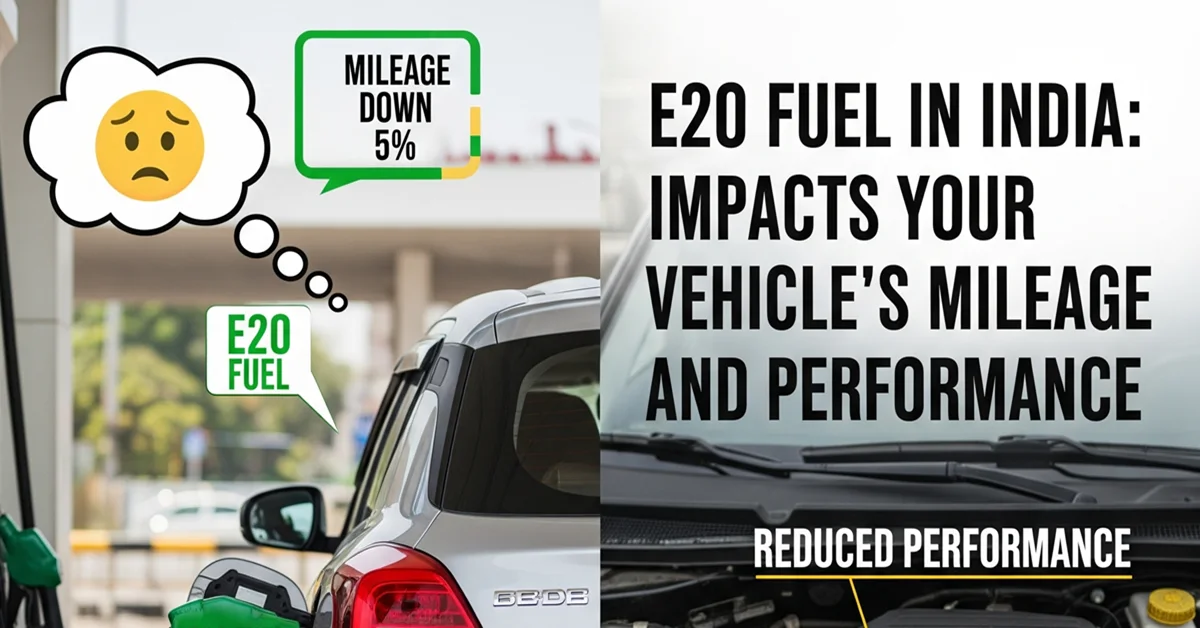
  • E20 Fuel in India: How It Impacts Your Vehicle’s Mileage and Performance

    E20 Fuel in India: How It Impacts Your Vehicle’s Mileage and Performance

    India is steadily moving towards cleaner and more sustainable fuels. One major step in this journey is the rollout of E20 petrol—a blend of 20% ethanol and 80% petrol—at fuel stations across the country. While it promises environmental and economic benefits, many vehicle owners are noticing slight changes in their car’s performance and fuel efficiency. This article explains what E20 fuel is, why it is being introduced, and how it can affect your vehicle’s mileage and maintenance costs.


    What Is E20 Fuel?

    E20 petrol contains 20% ethanol mixed with petrol. Ethanol is a renewable bio-fuel produced mainly from sugarcane, maize, and other crops. This blending helps reduce India’s dependence on imported crude oil and lowers greenhouse gas emissions.

    Key Objectives of E20 Fuel

    • Lower carbon emissions and move towards cleaner energy.
    • Reduce import bills by using domestically produced ethanol.
    • Boost the rural economy by supporting farmers producing ethanol feedstock.

    Why E20 Can Affect Fuel Efficiency

    Ethanol has a lower energy density compared to pure petrol. This means each litre of E20 contains less energy than regular petrol. When your engine burns this fuel, it may need slightly more quantity to produce the same power—leading to a small drop in fuel efficiency.

    Typical Mileage Drop Observed

    • For newer vehicles designed for E20: about 2% drop.
    • For older vehicles designed for E10 or lower: up to 4-5% drop in some cases.

    This drop isn’t drastic but can be noticeable if you track your mileage carefully.


    Impact on Vehicle Components

    Apart from mileage, ethanol can also interact differently with engine materials. Modern vehicles use fuel-compatible hoses, seals, and gaskets, but older cars may see:

    • Faster wear of rubber hoses and gaskets.
    • Increased moisture absorption, which can lead to corrosion if left unchecked.

    Automakers have already started rolling out E20-compatible models to counter these effects.


    Comparative Table: E20 vs Conventional Petrol

    Feature / ParameterConventional Petrol (E0/E10)E20 Petrol (20% Ethanol)
    Ethanol Content0–10%20%
    Energy Content per LitreHigherLower (approx. 5% less)
    Average Fuel Efficiency ImpactNo change2–5% drop
    CO₂ EmissionHigherLower
    Price BenefitSlightly cheaper per litreSlightly cheaper per litre
    Vehicle CompatibilityAll vehiclesOnly E20-ready vehicles recommended

    Tips for Vehicle Owners Using E20 Fuel

    1. Check your car’s compatibility: Look at your owner’s manual or ask your dealer whether your vehicle is E20-ready.
    2. Maintain your vehicle regularly: Replace hoses, seals, and fuel filters on schedule.
    3. Monitor mileage: Keep a log to see how E20 affects your real-world fuel economy.
    4. Use reputed fuel stations: Ensure fuel quality and correct blend ratios.

    Benefits of E20 Despite the Mileage Drop

    • Environmentally Friendly: Lower carbon footprint per kilometre travelled.
    • Economic Gains for Farmers: Increased ethanol demand supports rural livelihoods.
    • Reduced Oil Imports: India saves on foreign exchange by blending home-grown ethanol.

    The slight fuel efficiency loss is often offset by these larger benefits over the long term.


    Frequently Asked Questions (FAQs)

    Q1. Will using E20 petrol void my vehicle’s warranty?
    If your vehicle is certified as E20-compatible, it won’t void the warranty. Always check with your manufacturer.

    Q2. Can older cars run on E20 petrol?
    Yes, but they may experience slightly higher mileage drops and possible wear on rubber components. Periodic maintenance is essential.

    Q3. How much mileage drop should I expect?
    Typically 2-3% for new cars and up to 4-5% for older models.

    Q4. Is E20 petrol cheaper than regular petrol?
    In many regions, it’s priced marginally lower per litre, but because of lower energy content, cost per kilometre may be similar.

    Q5. Why is the government pushing E20 despite mileage concerns?
    It’s part of India’s long-term energy and environmental strategy to cut emissions, reduce oil imports, and support local farmers.


    Conclusion

    The rollout of E20 fuel in India is a landmark step towards sustainable energy. While a small drop in fuel efficiency is natural due to ethanol’s lower energy content, the environmental and economic advantages make it worthwhile. Vehicle owners can minimise issues by ensuring compatibility, following maintenance schedules, and monitoring performance closely.

    E20 represents a shift towards greener, more self-reliant transportation in India.


  • Big Relief for Small Businesses: GST Registration in 3 Days & Easier Refunds on the Way

    Big Relief for Small Businesses: GST Registration in 3 Days & Easier Refunds on the Way

    Small and low-risk businesses in India are set to get a major compliance boost soon. The government is rolling out reforms that will make GST registration automatic or much faster, and overhaul the refund system to reduce delays and ease working capital constraints. If you’re a small trader, startup, or MSME, here’s what you need to know.


    🧩 Key Proposed Reforms — What’s Changing?

    ReformWhat It Means in PracticeWho Qualifies / Risk ProfileBenefit to Businesses
    3-Day or Automatic GST RegistrationEligible applicants can get GST registration approved within 3 working days automatically, without manual verification, if they are “low risk”Small businesses whose monthly claims of Input Tax Credit (ITC) do not exceed a defined threshold (ITC ≤ ₹2.5 lakh/month in many drafts)Less waiting time, reduced paperwork, fewer delays in starting business operations
    Simplified / Optional Registration SchemeSmall suppliers, especially those selling via e-commerce platforms or crossing state lines, may have a simplified registration optionBusinesses that assess themselves as low risk, or cross thresholds, may opt in / opt outFlexibility, easier compliance burden
    Provisional Refund ClaimsRefunds (especially for exporters, inverted duty structure etc.) will be partly or mostly granted automatically (for example, 90%) on the basis of system risk-assessment, with minimal interventionTaxpayers with verified credentials, low risk flagged businesses; where mis-use risk is lowFaster cash flow, less time stuck waiting for refunds, easing working capital pressure
    Automated Refund ProcessingThe refund mechanism will be automated, using technology, risk assessment & pre-filled / system-generated inputs; less manual scrutiny unless flaggedThose in low risk or well documented track recordsReduced delays, fewer appeals or follow-ups with tax officials, more certainty

    🔍 Eligibility & Definitions

    • Low-Risk Businesses: Businesses which do not claim large amounts of ITC, whose past records show compliance, and which meet defined parameters (e.g. turnover, audit history, correctness of filings).
    • ITC Threshold: Some proposals suggest ₹2.5 lakh/month limit on ITC claims to stay in the “low risk / simplified” category.
    • Voluntary/Optional: Many reforms are optional — meaning businesses can opt into the simplified scheme if they qualify. If they later cross the thresholds (e.g. ITC claims beyond limit or risk profile changes), they can be moved to normal GST registration / scrutiny.

    ⚙️ When Will These Reforms Begin & How They Will Work

    • The reforms are expected to roll out from 1 November 2025 (or near that date) for many components (automatic / fast registration & provisional refunds).
    • The process will involve technology tools: risk scoring of applications, automated verification of supporting documents, system-based validation rather than manual officer intervention.
    • Refund process will also involve provisional payouts (e.g. 90%) where system verifies risk parameters; remaining amounts or full refunds where necessary after further checks.

    🏆 Benefits to Small Businesses

    • Faster setup & business commencement: Registration delays are a major hurdle; 3-day registration means less lead time.
    • Cash flow improvements: Faster refunds, especially for exporters or businesses with inverted duty costs, unlock working capital.
    • Reduced compliance burden: Less manual documentation / visits, simplified scheme reduces friction.
    • Predictability & transparency: Knowing that you qualify for fast registration or refund helps in planning finances, investment, hiring, etc.

    ⚠️ What to Be Cautious About

    • Risk Assessment & Verification: Even under simplified scheme, business must maintain correct records; non-compliance or errors could lead to delays or reversion to normal regime.
    • Change in Status: If your business crosses ITC or turnover thresholds, you may be moved to a normal GST registration process, with more checks.
    • Refund Disputes: Some refund applications may still require scrutiny; provisional refund doesn’t guarantee final acceptance without proper documentation.
    • Application Errors: Automated systems are fast but rigid; errors in filling forms or missing documents may lead to rejection or delays.

    🧮 Example: How It Helps a Small Exporter

    Suppose “ABC Exports” has regular GST registration delays, and often waits 30-45 days for Input Tax Credit or refund of IGST (export-related). Under the new reforms:

    • They apply for registration, flagged “low risk,” get it in ~3 working days.
    • They make a refund claim; 90% of the refund amount provisionally disbursed within 7 days (or similar timeframe), pending system verification.
    • Less friction dealing with tax officers, fewer visits or document submissions.

    This means significant reduction in funds blocked, fewer operational delays, smoother finance management.


  • Kia India Pre-GST Festive Offers: Save Up To ₹2.25 Lakh on Seltos, Carens & More Before 22 September 2025

    Kia India Pre-GST Festive Offers: Save Up To ₹2.25 Lakh on Seltos, Carens & More Before 22 September 2025

    Kia India has launched one of the most aggressive automotive campaigns this festive season — its Pre-GST Festive Offers. With GST rate changes around the corner, Kia is allowing buyers to lock in huge discounts on its best-selling models before 22 September 2025. The combined benefits from tax rate adjustments and special festive incentives translate into savings of up to ₹2.25 lakh — a rare opportunity in the Indian car market.


    🌟 Why “Pre-GST” Matters

    India’s GST Council has rationalised taxes on several goods, including automobiles. Prices are set to change once the new rates come into effect after September 22. By making these offers “pre-GST”, Kia is ensuring customers can capture the benefit of existing tax rates plus additional discounts before prices reset. In effect, buyers are getting two layers of savings:

    1. Pre-GST Advantage — Locking in the lower ex-showroom price before new taxes/structure apply.
    2. Festive Bonus — Extra manufacturer/dealer incentive on top of the tax advantage.

    This strategy not only clears dealer inventories but also gives customers a chance to purchase a premium Kia at a mid-segment price.


    📊 Kia Pre-GST Offer: Model & Region Wise Savings

    Model / VariantRegion / StateApprox. Total Savings (₹)
    SeltosKeralaUp to 2,25,000
    SeltosAndhra Pradesh & TelanganaUp to 2,00,000
    SeltosKarnatakaUp to 2,10,000
    SeltosNorth / East / WestUp to 1,75,000
    CarensTamil NaduUp to 1,55,650
    CarensKarnataka & Other States1,10,500–1,45,500
    Carens ClavisKerala, Tamil Nadu etc.Up to 1,25,650
    Carens ClavisOther Regions1,20,000–1,45,500
    Sonet & Syros (select variants)All IndiaGST-based reductions up to ~1,64,000–1,86,000

    Figures represent combined Pre-GST savings and special festive discounts.


    📝 Deep Dive: How Customers Benefit

    • Higher Variants = Higher Savings: Premium trims like Seltos GTX or Carens high-spec variants enjoy the biggest rupee benefit.
    • State-by-State Differences: Because local taxes and dealer incentives vary, the same model can carry different savings in Kerala vs Karnataka.
    • Timing is Crucial: Only cars invoiced before 22 September qualify for the Pre-GST price plus festive bonus. After this date, the new GST pricing structure applies.
    • Attractive Finance Options: Many dealers are combining these discounts with low-interest EMI schemes, further enhancing affordability.

    🏆 Strategic Edge Over Rivals

    While other carmakers offer festive discounts, Kia’s Pre-GST positioning adds a unique layer of urgency. Competitors may match incentives, but very few combine tax benefits and cash discounts so transparently. This approach:

    • Helps Kia clear inventory before GST changes.
    • Gives buyers an exceptional price advantage.
    • Enhances Kia’s image as a customer-friendly, agile brand.

    ⚠️ Key Points for Buyers

    • Check with your local dealer for variant availability — stocks may be limited due to high demand.
    • Ensure the complete Pre-GST + Festive benefit is mentioned on the invoice for transparency.
    • Understand that prices will be revised post 22 September 2025 under the new GST regime.

  • EPFO’s Diwali Gift for Non-Government Employees: Minimum Pension Hike & Instant PF Withdrawals

    EPFO’s Diwali Gift for Non-Government Employees: Minimum Pension Hike & Instant PF Withdrawals

    The Employees’ Provident Fund Organisation (EPFO) is preparing a major festive-season reform for India’s workforce. If approved in the upcoming board meeting, millions of non-government employees could benefit from a higher minimum pension and a new instant PF withdrawal facility. Here’s a detailed look at what’s on the table, how it affects you, and why it matters.


    🔑 Highlights at a Glance

    FeatureCurrent ScenarioProposed ChangeLikely Impact
    Minimum EPS Pension₹1,000/month baseline for eligible pensionersHike to ₹1,500–₹2,500/month (under discussion)Higher monthly income for lowest-paid retirees
    PF Withdrawal ProcessClaims filed online/offline; payout time 3–10 working daysInstant withdrawals via ATM/UPI, part of EPFO 3.0Emergency access to funds; bank-like convenience

    📝 Detailed Explanation

    1️⃣ Minimum Pension Hike

    For years, trade unions and pensioner associations have demanded an increase in the EPS minimum pension. At present, the lowest slab stands at ₹1,000 per month, which has not kept pace with inflation. The EPFO board will examine a proposal to raise this to somewhere between ₹1,500 and ₹2,500 per month.

    This move would directly benefit the most vulnerable pensioners, giving them more disposable income and improving their quality of life. It also signals the government’s intent to strengthen social security for private-sector workers.

    2️⃣ Instant PF Withdrawal Facility (EPFO 3.0)

    Currently, even online EPF withdrawal requests can take several days to process. The proposed system aims to integrate EPFO accounts with ATM cards and UPI platforms, allowing subscribers to withdraw partial funds instantly. This would make the PF system operate more like a banking account, reducing stress during emergencies such as medical expenses or urgent family needs.

    3️⃣ Impact on Different Segments

    • Mass-market workers: immediate access to funds + a higher pension.
    • Mid-income employees: more flexibility without disturbing long-term savings significantly.
    • Retirees: a tangible pension increase to offset rising costs.

    📊 Category-Wise Impact Table

    Category of SubscriberKey Benefit from Proposed ReformPossible Concerns
    Existing EPS Pensioners at Minimum LevelHigher monthly pension (₹500–₹1,500 more per month)Budgetary strain if funding not defined
    Active EPF MembersQuicker access to PF money through ATM/UPIRisk of dipping into retirement corpus too often
    EmployersSmoother process for employees’ emergency needsNeed for communication & updated HR processes
    EPFO AdministrationModern image; reduced paperworkSecurity, fraud-prevention & IT costs

    ⚠️ Things to Watch

    • Final decision at the EPFO Board Meeting in October 2025.
    • Eligibility criteria for instant withdrawals (caps, conditions).
    • Whether the pension hike will be fully funded by EPFO or partly subsidised.
    • Data security and fraud protection for ATM/UPI withdrawals.

    💡 Why This Matters

    A stronger social-security net plus easier fund access can boost workforce morale and consumer spending. However, it must be balanced with preserving the retirement corpus and maintaining EPFO’s long-term sustainability.


    ❓ FAQs

    Q1. When will the higher minimum pension take effect?
    A: Only after the EPFO Board approves and issues a notification. The proposal will be discussed in the October 2025 meeting.

    Q2. How much will the minimum pension increase by?
    A: Proposals range from ₹1,500 to ₹2,500 per month, up from the current ₹1,000.

    Q3. Will instant PF withdrawals allow the full balance?
    A: No. Only partial withdrawals are expected to be allowed (exact caps yet to be announced).

    Q4. Do I need a new card or app for ATM/UPI withdrawals?
    A: Likely yes; EPFO may issue new credentials or integrate with your existing bank KYC to enable the facility.

    Q5. Will this affect my employer’s contribution?
    A: No change in contribution rates has been announced. The reform is about withdrawal convenience and pension amounts.


  • GST Cut 2025: HUL Slashes MRPs on Dove, Horlicks, Lux & More — Full Price List & Savings

    GST Cut 2025: HUL Slashes MRPs on Dove, Horlicks, Lux & More — Full Price List & Savings

    After the GST Council’s recent rationalisation (many everyday items moved from higher slabs to 5%), Hindustan Unilever announced a wide-ranging MRP revision effective 22 September 2025 and published revised retail prices for dozens of popular SKUs. Below is a clear, SEO-friendly, long-form breakdown you can use as a blog post: full product table (popular SKUs announced so far), category summaries, analysis of how the cuts affect value / premium positioning, and 5 FAQs.


    What happened

    The GST Council’s rate rationalisation – shifting many everyday personal-care and packaged-food items to a lower slab – prompted FMCG companies to update MRPs across large parts of their portfolios. Hindustan Unilever (HUL) revised retail prices on a number of its flagship SKUs (effective 22 September 2025) to pass on the GST benefit to consumers. This move covers personal-care staples, soaps, nutrition and packaged food and drinks.


    📊 Full HUL SKU Price Table (old MRP → new MRP, ₹ savings and %)

    CategoryProduct (Pack)Old MRP (₹)New MRP (₹)You Save (₹)You Save (%)
    Personal Care – PremiumDove Shampoo – 340 ml4904355511.22%
    Personal Care – MidDove Shampoo – 180 ml1651452012.12%
    Soap – BeautyLux Soap – 100 g3530514.29%
    Soap – Hygiene (Mass)Lifebuoy – 125 g3328515.15%
    Soap – MultipackLifebuoy 75 g × 4 Pack6860811.76%
    Nutrition – PremiumHorlicks – 1 kg3903504010.26%
    Nutrition – Small JarHorlicks – 200 g1301102015.38%
    Packaged FoodKissan Jam – 200 g90801011.11%
    Beverages (Instant Coffee)Bru Coffee – 100 g1801602011.11%

    (Percent saving = (Old – New) ÷ Old × 100.)


    Category summary — total impact at a glance

    • Soaps & personal-care: Consistent double-digit percentage reductions (≈11–15%). Mass soaps (Lifebuoy) and beauty soaps (Lux) both show healthy percent reductions; absolute rupee savings are small for low-priced bars (₹5–₹8), but percentage impact is meaningful for consumers on tight budgets.
    • Shampoos (premium): Premium shampoos such as Dove show larger absolute rupee savings (₹20–₹55), and percent cuts (~11–12%) mirror other categories — a tangible drop in wallet pain for higher-ASP SKUs.
    • Nutrition & packaged foods: Horlicks, Kissan and other packaged food SKUs saw single-SKU savings of ₹10–₹40 (≈10–15%), which will be visible at checkout and may nudge incremental purchases.

    Visual: Savings by category (quick interpretation)

    • Average percent saving across published SKUs: ~12–13% (varies SKU to SKU).
    • Absolute rupee savings: Higher for premium items (e.g., Dove 340 ml ₹55; Horlicks 1 kg ₹40). For low-ticket staples the rupee fall is small (₹5–₹10) but still relevant in bulk shopping.

    Deep dive: Cheap (mass) vs Premium brands — who benefits more?

    1) Absolute savings vs percentage savings
    Premium SKUs (higher MRP) deliver bigger absolute ₹ savings even when percent cut is similar. Example: Dove 340 ml (₹55 saved) vs Lifebuoy single bar (₹5 saved). For consumers, this means premium buyers see larger one-time reductions on each unit purchased.

    2) Basket impact
    A family buying multiple low-ticket soaps, shampoos and staples each month will see compounded savings. For example, buying 10 bars of Lifebuoy at the new price saves ₹50 across the basket — comparable to one mid-size premium SKU saving. That means mass brands’ reductions can be equally meaningful in everyday household budgets.

    3) Brand positioning and marketing
    HUL’s public move to publish price cuts signals a consumer-facing positioning: pass-through of policy benefits rather than pocketing the GST advantage. This may help HUL protect premium brands’ volumes (premium buyers feel rewarded) while using mass brand price drops to support volume growth in value-sensitive segments.

    4) Competitive dynamics
    When major players pass on cuts, smaller rivals may need to follow to protect market share, especially on entry-price SKUs. Analysts expect the FMCG sector’s overall demand to get a short-to-medium-term boost as a result.


    Practical examples — how much a household could save (illustrative)

    • Household A (small family): weekly basket = 1 × Dove 340 ml, 4 × Lifebuoy soap (75g), 1 × 200g Horlicks
      • Savings = Dove ₹55 + (4 × Lifebuoy single bar saving) + Horlicks 200g ₹20 → ~₹80–₹100 per week depending on pack mix.
    • Household B (value shopper): buys soaps, jam and instant coffee in bulk — smaller absolute but consistent percent benefits which add up monthly to meaningful amounts.

    Compliance & practical notes (labelling, stock already in trade)

    Government agencies asked companies to monitor MRPs and ensure consumers receive benefits; firms are expected to publish revised MRPs via public notices/ads and make changes on packaging/inventory or display reduced MRPs at point of sale. Retailers must reflect new prices from the effective date; unsold old-priced stock may be labelled/stickered with revised MRPs.


    What this means for consumers, retailers & investors

    • Consumers: immediate relief — lower checkout bills, especially if shopping for frequently used SKUs.
    • Retailers: need to manage stock labeling, POS updates and communicate new MRPs to customers to avoid confusion. There may be small margin pressure for some SKUs if retailers don’t adjust margins/commissions.
    • Investors/analysts: generally view GST rationalisation as positive for FMCG demand and market expansion; many expect volume improvement over time even if near-term margins may shift.

    Readability checklist (for publication)

    • Use the table above near the top for scannability.
    • Add small thumbnail images of the listed SKUs (optional) with ALT text including the SKU name + “new price”.
    • Add a short consumer action box: “How to check MRP in store” (look at packaging, ask retailer, check shelf labels) and “What to do if retailer charges old MRP” (ask for updated bill / report to consumer helpline).

    FAQs

    Q1 — When do the new HUL prices take effect?
    A1 — HUL’s published revised MRPs are effective 22 September 2025 (the date companies were asked to implement GST-linked re-pricing).

    Q2 — Will all HUL products get cheaper?
    A2 — Not necessarily every single SKU: the announced cuts cover many everyday personal-care, soap, nutrition and packaged-food SKUs. The quantum varies by product and pack size. Expect other SKUs to be updated in waves as companies adjust packaging and POS labels.

    Q3 — How much will I save on premium vs mass products?
    A3 — Percent reductions are broadly in the same double-digit band (≈10–15%), but premium items yield larger absolute rupee savings (e.g., ~₹55 on a bigger Dove bottle) while mass staples yield smaller rupee savings but similar percentage relief. (See the SKU table above for examples.)

    Q4 — What if a shop still charges old price after Sept 22?
    A4 — Ask the retailer for the revised price/advertisement proof. If unresolved, you can report to local consumer-protection forums or the relevant state legal metrology/consumer helpline — but first confirm whether the retailer is selling old-label stock which may require relabelling or a stickered MRP.

    Q5 — Will other FMCG companies follow HUL?
    A5 — Many FMCG companies are already announcing or expected to announce similar pass-throughs to remain competitive and comply with regulatory guidance; the overall sector is expected to benefit from increased demand.